AlphaOmega: five ads written from the market signal, drafts, internal
Every ad started as a real question or situation typed under the clinic's own ads, never as a brief. No patient sentence is printed in any ad, because the clinic's own compliance record says testimonials run with written consent and nobody here has given it; the ads answer what people asked. Each one was chiefed by two model families, revised, verified, and saved to the database as a draft. Nothing here has been sent to AlphaOmega, Daniel or Dee, and nothing has reached Meta.
Five units, copy and (where built) a picture5 units
Where a picture exists it carries the market's own question or the clinic's own line, never a patient outcome, and it was read back with optical character recognition so every word on it is accounted for.
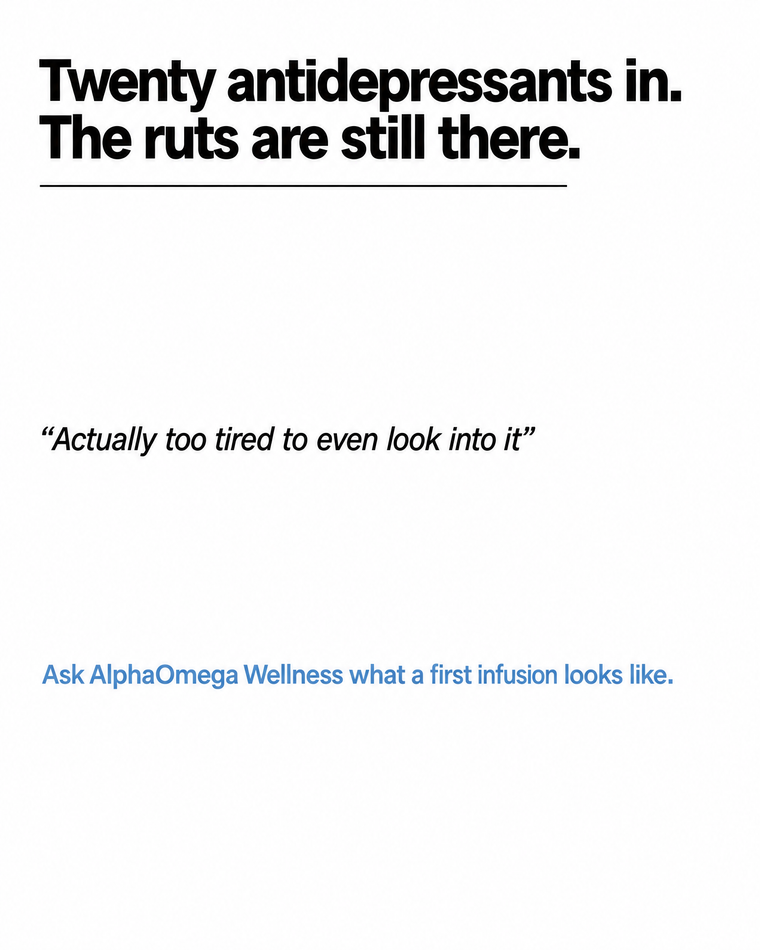 4:5
4:5IV ketamine did for an ER doctor what decades of antidepressants couldn't: remission. Not a stronger pill. A bulldozer for the ruts chronic stress wears into the brain.
A Doctor Off Daily Meds, Himself Again With IV Ketamine After Years Of Failed Prescriptions
After twenty years in emergency medicine, the doctor who now runs this clinic found what finally put his own depression into remission.

One course of IV ketamine did what decades of antidepressants hadn't, and he no longer takes a daily med for depression.

And there's more than one doctor's word behind that.

Ketamine is FDA-approved as an anesthetic. Its use for depression, anxiety and PTSD is off-label, and it's supported by clinical research.

The belief that keeps people on the medication carousel is that depression is a chemistry problem, so the fix has to be a better chemical.

So the next prescription gets its six to twelve weeks. Then the taper. Then the next one.

Week one on the new prescription, and the hope is back... maybe THIS is the one.

Twelve weeks in, and the only thing it's changed is the side effects.

Some of those pills dulled everything at once (the good along with the bad) until the whole world came through a layer of felt.

Then weeks of tapering off before the next one can even start.

Somewhere in there the list of what's been tried runs past twenty: antidepressants, antipsychotics, mood stabilizers.

Twenty rounds of that, and the math is years.

And looking into one more treatment takes a kind of energy the depression already spent.

Somewhere in those years a quieter question shows up, usually late at night... is this just how the rest of it goes?

It's the question of someone who knows they should be further along by now, and who has every right to be.

That's exactly why IV ketamine therapy exists, and why it works on a different layer than any of those pills did.

Chronic stress, and the cortisol that comes with it, physically wears down nerve connections in the brain.

Thought starts running in ruts. The same worn grooves, the same loop, every day.

An antidepressant turns up the volume on a broken speaker.

The speaker stays broken.

IV ketamine works like a bulldozer.

A slow infusion switches on the brain's own repair signals, and new nerve connections start forming in the exact areas chronic stress wore down.

The ruts get cleared... and new paths can form.

A new antidepressant needs weeks before anyone knows whether it took, and patients here tend to describe the first shift after one of the early infusions.

Talk therapy works on the thoughts running through the ruts, and it was never built to clear the ruts themselves.

The other half of what's different here is who's in the room.

A board-certified physician administers and monitors every infusion, in a clinical setting, from the first minute to the last.

The doctor who runs this clinic describes his own infusion as a private room, a blanket, a comfortable chair, headphones with quiet music, and the lights turned down.

A calm dream he wasn't in a hurry to wake from.

His family noticed it first. Less irritable, less easily thrown by the things that used to grate all day.

The hard parts of life didn't vanish. He still didn't like them, and he felt able to get through them anyway.

That's what it did for him, and for hundreds of patients he's treated since: depression in remission, even when nothing else had worked.

One person who went through it described feeling like themselves again, a self they hadn't realized was missing.

So, about that question from the middle of the night.

Twenty failed pills were never a verdict on the person taking them.

Worn-down nerve connections CAN be rebuilt.

Here's what a course looks like, laid out plainly, because looking things up is the last thing anyone this tired has energy for.

* Six IV ketamine infusions over two to three weeks, each one a slow drip.

* A board-certified physician administering and monitoring every one of them, in a clinical setting.

* Counseling paired with each infusion, so the new paths have something to run on.

* Group sessions alongside the counseling, through the whole course.

If you're too tired to look into one more thing, that's fair, and it's why the next step is a conversation with the people who run the infusions.

Ask what the first infusion involves. Ask what six of them would look like around your life.

The other road is the one already walked: a new prescription, six to twelve weeks to find out whether it took, and the taper if it didn't.

Six infusions over two to three weeks is the whole course, start to finish, and the doctor who runs this clinic has been through one himself, as a patient.

Talk to the clinic, and let them do the looking from there.

Ketamine therapy is administered by a board-certified physician. Individual results may vary.

This is not a substitute for emergency mental health services. If you are in crisis, call 988.
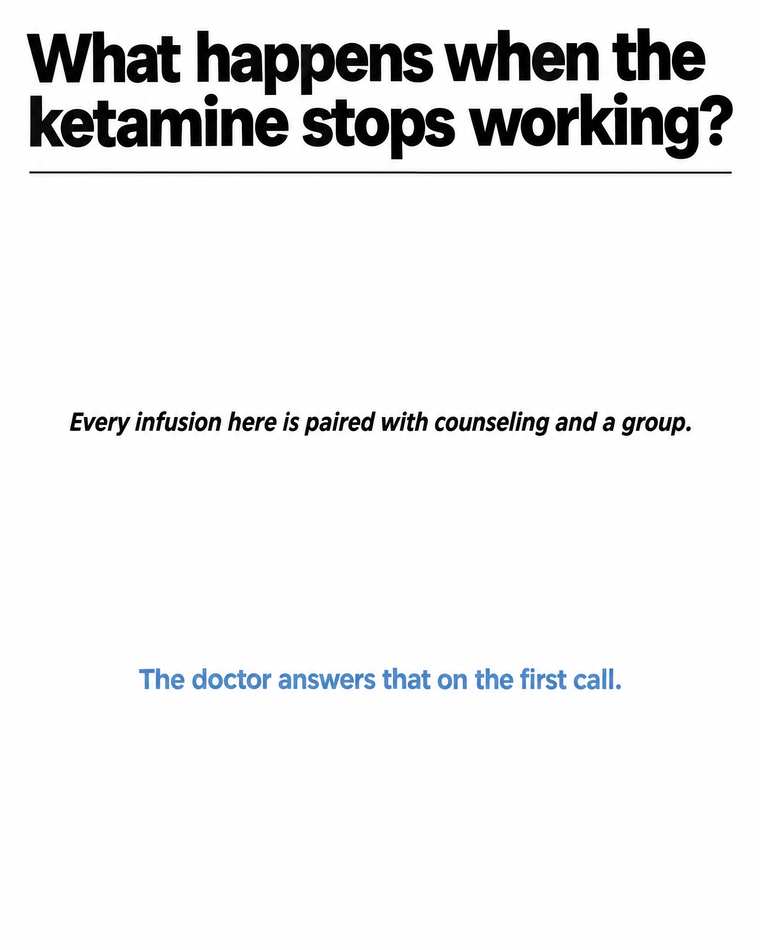 4:5
4:5Twenty failed antidepressants do NOT call for a twenty-first: IV ketamine patients describe getting themselves back, and the doctor answers, on the first call, whether it lasts.
Not Another Masking Pill: IV Ketamine Patients Say They Feel Like Themselves Again
This isn't a twenty-first prescription.

Not another orange bottle with a wait measured in weeks to find out whether this one holds, and not a dose bump at the next med check.

And talk therapy on its own doesn't fit here either, since it asks a person to think a way out of a rut the brain has physically worn in.

By the time the count hits twenty, the routine is familiar down to the details.

The pill organizer with the extra row. The psychiatrist's "let's give this one eight weeks." A folder of names that reads like a pharmacy shelf, SSRIs to mood stabilizers to the one that was supposed to be different.

Somewhere in that folder, the conclusion stops being about the pill...

It starts being about the person.

And the label on the chart, treatment-resistant, starts to sound less like a diagnosis and more like a verdict on whoever's wearing it.

Except the twenty had one thing in common, and it wasn't the person.

Each of them turned up the volume on a broken speaker. None of them touched the wiring underneath.

Instead, this clinic built a six-infusion course around a different job: switching the brain's own repair signals back on, in a monitored room, with a board-certified doctor in it.

The doctor who runs it spent years on the other side of that folder first.

Twenty years in emergency medicine, a long run of prescriptions that never held, and a first IV ketamine infusion tried as a last resort, as a patient.

What happened in that chair is the reason the clinic exists.

The twenty prescriptions were aimed at the symptom. The cause sits a layer down.

Years of chronic stress and high cortisol physically wear down nerve connections in the brain, the way water wears a rut into a hillside.

Thoughts start running the same worn path because it's the only path left with a groove in it.

An antidepressant turns up the signal running through those ruts, and the ruts stay right where they were.

Ketamine, given as a slow IV drip in a clinical setting, does a different job from the pills entirely.

It switches on the brain's own growth signals, and new nerve connections start forming in the areas chronic stress wore down.

The closest picture is a bulldozer...

Once the ruts are cleared, new, healthier thought patterns have room to form.

The volume was never the problem.

So what happens when it wears off?

Nobody at this clinic will PROMISE it lasts.

What the clinic can say is what it does with the window an infusion opens.

Every one of the six infusions here is paired with structured integration (counseling and group sessions) built so that window gets used for lasting change instead of left to close on its own.

The infusion clears the rut. The integration work is where a new path gets walked.

That pairing is what separates this course from an infusion-only clinic, and it's the part that gives "and then what" an actual answer.

The course itself has a fixed shape (six infusions over two to three weeks) and a set job.

What comes after the sixth is the doctor's to answer, and the doctor answers it on the first call.

As for the word experimental: ketamine is FDA-approved as an anesthetic.

Its use for depression, anxiety and PTSD is off-label, and the clinic says so in exactly those words.

A board-certified physician administers and monitors every infusion here, in a clinical setting, start to finish.

People who've been through ketamine therapy tend to describe it in small ways first.

The drive home with the sun on the windshield. A smile that showed up without being arranged.

Good news landing as good news, bad news landing as bad news, and neither one deciding how the week goes.

Stable is the word one of them used, and it's the one that sticks.

The doctor tells the same kind of story about himself: his family noticed before he did. The things that used to grate at him still showed up. He just got through them.

And the line people come back to, more than any number, is the one about recognizing themselves again.

Someone they'd quietly stopped expecting to see.

Twenty prescriptions that never held say something about the prescriptions.

The brain they were aimed at had been worn down, and worn down is a different word from broken.

Worn down is what new nerve connections grow back over.

Left alone, the routine has exactly one next move, and it comes in an orange bottle.

If you're twenty prescriptions in and the word broken has started to sound like it belongs to you, the first call with the doctor is where the wears-off question gets a straight answer, in plain terms.

Not a sales script. A conversation about what the course does and what comes after the sixth infusion.

Bring that question to the call.

Ketamine therapy is administered by a board-certified physician. Individual results may vary.

This is not a substitute for emergency mental health services. If you are in crisis, call 988.
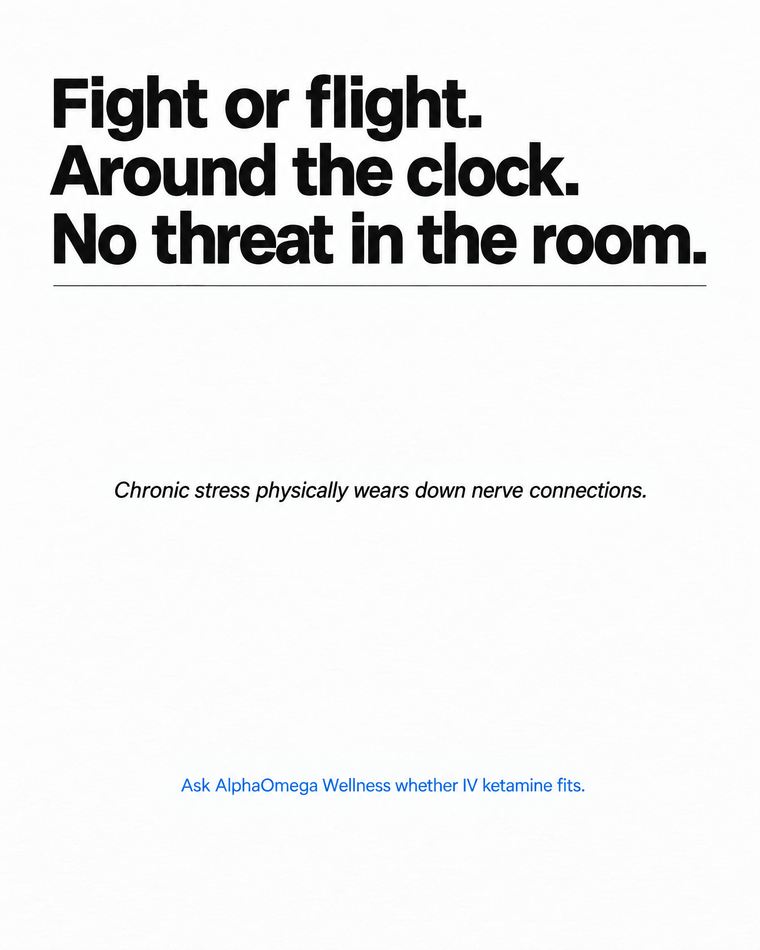 4:5
4:5How patients go from constant fight or flight to sleeping through the night without more talk therapy that plateaued, by treating the damage stress left behind.
Patients Describe Survival Mode Turning Into A Full Night's Sleep After Talk Therapy Stalled
Some brains never got the message that the emergency ended.

The alarm stayed on, and every day since has been lived inside it.

It starts before the eyes are open.

The stomach churns first, then the jaw locks, and the day hasn't even started yet.

By the time the coffee's poured the body is braced for something, and nothing in the kitchen can say what.

Fight or flight. Around the clock. With no threat in the room.

Years of it, for some people.

Years of being the one who holds everyone else together (a sick kid, a house that runs on one person's nerves) while the body keeps a sword over its own head.

Sleep comes late, breaks before it's done, and hands back a morning that already feels used.

Two years of weekly therapy taught the words for it. The words didn't turn the alarm off.

Somewhere in there, a worse question shows up.

The quick temper, the eyes that check every exit before anyone speaks... all of it was built for surviving something.

Take the surviving away and what's left?

So the suffering starts to feel like the one thing that's actually theirs.

The alarm never tires. The person does.

Left long enough, the traits built for the emergency become the only personality anyone remembers, including the person wearing them.

The doctor who runs this clinic spent twenty years in an emergency room, in front of thousands of people struggling with their mental health, and then became an IV ketamine patient himself.

What a last resort taught him is the part almost nobody explains: where the damage actually sits.

Years of stress hormones, cortisol most of all, physically damage the nerve connections in the brain.

The wiring wears into ruts, and every thought runs down the same ruts whether or not anything is wrong today.

The anxiety, the low mood, the irritability: all of it sits downstream of wiring that took the hit.

Which is why this treatment aims at the damage instead of the symptoms.

IV ketamine, given as a slow drip, works like a bulldozer on those ruts: it prompts the brain to grow new nerve connections and route around the old ones.

The clinical word is neuroplasticity. In plain words, the brain gets a chance to rebuild what stress tore down.

The drip opens the window. The brain does the building.

Antidepressants, the way this clinic puts it, turn up the volume on a broken speaker.

Talk therapy works on the story, and the story matters, and wiring that took a physical hit doesn't change from a conversation alone.

Neither one is aimed at the ruts.

The first question anyone asks about ketamine is whether it's safe to do this to a brain that's already struggling.

The clinic answers that with what it does: a board-certified physician administers and monitors every infusion, in a clinical setting, start to finish.

Ketamine is FDA-approved as an anesthetic. Its use for depression, anxiety and PTSD is off-label, and it's supported by clinical research.

Then the quieter question: who's left if the suffering goes?

People who've been through ketamine therapy describe something other than an erasure.

One of them put it as being handed a life that was never there in the first place, instead of getting an old one back.

The change patients describe is a plain one: motivation coming back, and the old hobbies picked up again.

The same doctor says his own family noticed before he did: the irritability went quiet, and the things that used to grate still weren't fun, they just stopped grating.

Good news lands as happiness. Bad news lands as sadness that stays the right size.

Sleep that goes through the night, and a morning on the other side that arrives unused.

That's a report from people who've been through it, and it's a report, never a promise.

The personality built for the emergency was a job, and a job can be set down.

So that's what IV ketamine therapy at AlphaOmega Wellness is aimed at: the damaged wiring underneath the alarm, and the ruts the alarm keeps running in.

That doctor's own first infusion, as a patient, went like this: a private room, a blanket, a comfortable chair, headphones playing quiet music, and the lights going down once the IV started.

A course is a series of infusions, and the clinic sets the number and the spacing.

If you've read this far, you already knew ketamine therapy exists. What you're deciding is where to do it, and whether that place is aiming at the damage or at the mood.

What waiting may cost is more time inside the alarm.

Nothing here tells you what your outcome will be.

So ask the clinic whether IV ketamine fits.

Ketamine therapy is administered by a board-certified physician.

Individual results may vary. This is not a substitute for emergency mental health services. If you are in crisis, call 988.
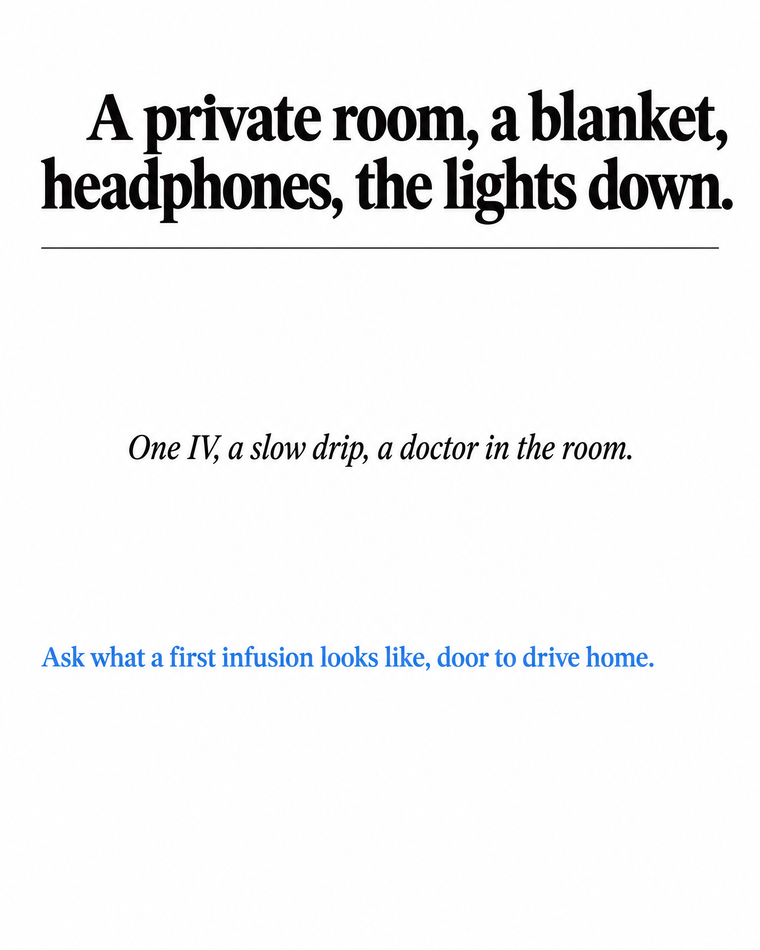 4:5
4:5How people who've tried everything for their depression describe color coming back after years of gray, and feeling like themselves, after a slow IV drip in a quiet room.
Technicolor Again And Their Old Selves Back, After Years Of Failed Pills
For the people who stopped counting prescriptions, what came back was mostly small things.

Color, vivid again after years of gray.

Appetite. Music that's worth listening to again.

Old hobbies coming back off the shelf...

And laughing more.

Small things count for a lot, coming from people who'd stopped expecting any of them.

The physician who runs the room at AlphaOmega Wellness was one of those people first, as a patient, before the practice offered a single infusion.

What he came back with was an explanation that starts in the brain instead of the mood.

Chronic stress, and the cortisol that rides along with it, physically wears down nerve connections in the brain.

Over enough years the worn-down connections settle into ruts, and the same low thought keeps running the same track.

The low mood is a worn track, and a worn track can be rerouted.

A standard antidepressant works on the chemistry that carries signals along the paths already there (the clinic compares it to turning up the volume on a broken speaker).

Ketamine works on the paths THEMSELVES.

Delivered slowly through an IV, it prompts the brain to grow new nerve connections in the areas chronic stress wore down.

The clinic's own word for it is a bulldozer... one that clears the ruts so a new pattern has somewhere to form.

Ketamine is FDA-approved as an anesthetic. Its use for depression, anxiety and PTSD is off-label, and it's supported by clinical research.

A standard course is six infusions across two to three weeks, and each infusion is paired with a counseling session and a group.

The infusion is the part that happens in the chair. The counseling and the group are the part that happens around it, with somebody to talk to.

So what about the needle, and what does the room actually look like?

A private room of their own.

A comfortable chair, a blanket, a pair of headphones with quiet music on them... and the lights go down once the IV starts.

The IV itself is a slow drip, and a board-certified physician administers and monitors every infusion in a clinical setting.

Most of the visit is spent in that chair with the music on (the drip does its work at its own pace).

The physician who sat in that chair first has treated hundreds of patients since, and what comes back from them is mostly ordinary.

His own family noticed it first, he says. The irritability gone, the easy frustration gone, and the things that used to bother him still there, no longer grating on him.

Some describe their own reactions back under their own control, with a mood no longer deciding the day for them.

People who have been through it describe having something to look forward to again, which for this group is news.

And the line that comes up, in one form or another, is feeling like themselves again... a person they'd stopped expecting to see.

Brain health is the plan, and it's a different plan from managing a mood.

Whether any of this is the right fit is a question only the clinic answers, and it answers it one person at a time.

You already know what ketamine therapy is.

What's left is whether this is the room to do it in, and that question doesn't answer itself.

Left unasked, it stays exactly where it is, and so does everything waiting on the answer.

Bring the needle question, the room question and the music question with you, because the clinic has heard each one before.

Ask AlphaOmega Wellness what's still open about that room, and settle the question with answers instead of a guess.

Ketamine therapy is administered by a board-certified physician. Individual results may vary.

This is not a substitute for emergency mental health services. If you are in crisis, call 988.
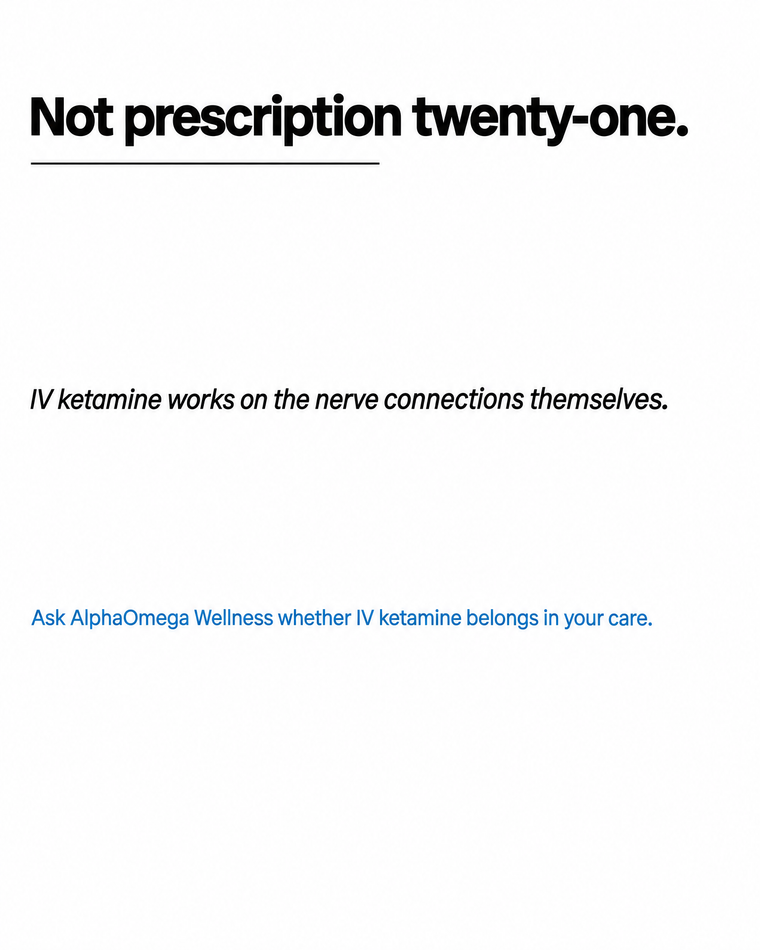 4:5
4:5Twenty failed antidepressants do NOT mean a broken person: IV ketamine rebuilds the nerve connections chronic stress wore down, instead of one more pill adjusting chemical levels.
Twenty Antidepressants Later, Not A Broken Person: IV Ketamine Repairs Stress Damage
This is NOT prescription twenty-one.

Not another SSRI, the kind that takes four to eight weeks to build up before anyone can tell whether it's working.

And then delivers half a response, a flat mood, and weight that wasn't there before.

It's not the nasal spray taken in a clinic chair, either, the one made from a derivative of ketamine.

Because when the answer is always one more bottle, from one more drug class...

The bottle stops being the problem. The pattern is.

The pharmacy text says the new one is ready.

A new orange bottle, a side-effect sheet stapled to the bag, and the same private sentence that came with the last one: maybe this one.

A month or two of the pill organizer (two rows, Monday through Sunday), then the follow-up where the dose gets bumped and the words are "let's give it a little longer."

The side effects show up long before any benefit does.

Then the crash... on schedule, and a new appointment to start the loop again.

Hope, then the crash, enough times in a row that the thought stops being about the pills at all.

It turns into something quieter and much worse: maybe this is just how it's going to be, for good.

Instead of adding a twenty-first bottle to that history, AlphaOmega Wellness runs ketamine itself, through a slow IV infusion, and aims it at the nerve connections stress wore down.

The physician who founded the clinic came to that infusion by the same road: decades of antidepressants that didn't hold.

And twenty years in emergency medicine, with thousands of people struggling with their mental health.

Which is why the clinic runs on one idea about depression, and the idea starts with stress.

Chronic stress does physical damage inside the brain.

Years of it, and the cortisol that comes with it, wear down the nerve connections in the parts of the brain stress hits hardest.

Until thought runs in ruts it can't climb out of.

Antidepressants adjust chemical levels. On a brain like that, it's turning up the volume on a broken speaker.

Ketamine, run slowly into a vein, works on the connections themselves.

Less a volume knob than a bulldozer: it clears the ruts, and new, healthier thought patterns get room to form.

Ketamine is FDA-approved as an anesthetic. Its use for depression, anxiety and PTSD is off-label, and it's supported by clinical research.

One word has been doing two jobs, in clinic waiting rooms and in the comments under ads like this one...

The nasal spray borrowed the name. What goes into the IV here is ketamine ITSELF.

A board-certified physician administers every infusion and monitors it, start to finish, in a clinical setting.

The course is six infusions over two to three weeks, each one paired with counseling and a group.

Two different things have been wearing one name, and only one of them goes in a vein.

So where does that thought come from, the one that says this is just how it's going to be, for good?

From evidence. Twenty prescriptions of it.

The founding physician carried it for decades, with his own failed antidepressants behind it, and IV ketamine is what changed his mind.

Twenty failed prescriptions are evidence about twenty prescriptions.

Never about the person.

What patients describe afterward is mostly about size.

Good news lands as good news again. Bad news lands at its actual size, and passes.

The founding physician says his own family noticed the change before he did.

The things that used to grate on him still showed up. He still didn't like them. They just stopped running him.

He describes the infusion itself as quieter than the word ketamine suggests: a private room, a blanket, headphones with soft music, the lights turned down.

Patients describe it as feeling like themselves again... and sometimes as meeting a self they hadn't known was missing.

Twenty failed antidepressants were never a verdict on the person.

In that story the brain was the part that got hurt, never the enemy.

Whether that history makes someone a fit for IV ketamine is a medical question, and only the clinic's physician answers it.

If the medication carousel is where your last several years went, prescription twenty-one costs what the other twenty cost: another few months of waiting to find out.

Which makes the fit question worth asking before prescription twenty-one, instead of after it.

Ask AlphaOmega Wellness whether IV ketamine belongs in your care. The physician answers that question plainly, in both directions.

Ketamine therapy is administered by a board-certified physician. Individual results may vary.

This is not a substitute for emergency mental health services. If you are in crisis, call 988.